
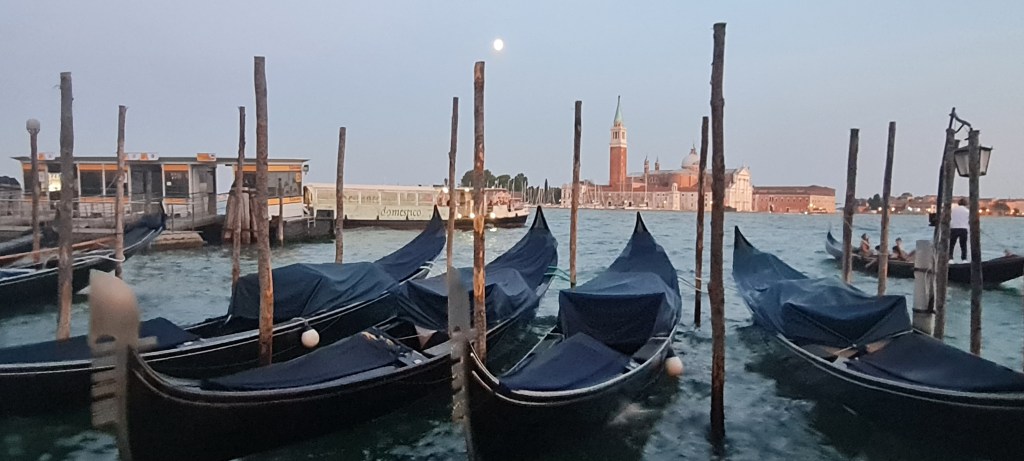
Not far from our accommodation in Venice, in the heart of this glorious city historically entwined with the seas is a organisation focused on oceanic thought and action—Ocean Space. Housed in the beautifully restored Church of San Lorenzo, Ocean Space more than a physical space but a conceptual platform bringing together art, science, and activism to address the critical issues facing our oceans.
A Hub for Oceanic Thought
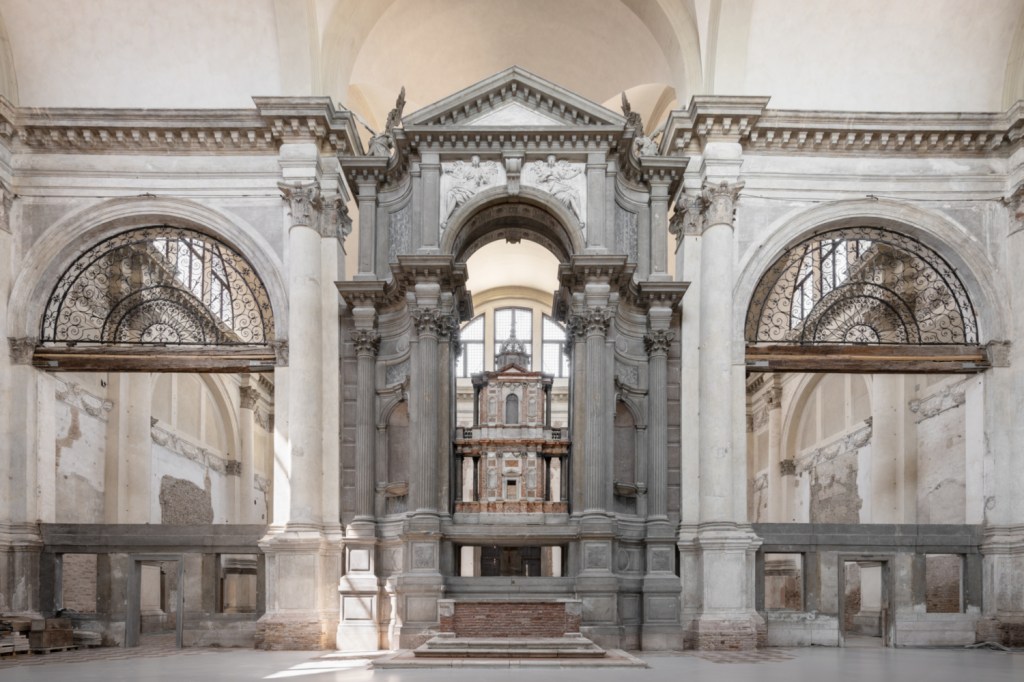
According to the website, Ocean Space is more than a gallery, its goal is to be dynamic collaborative platform that ignites the imagination and inspires action towards the protection and preservation of our oceans. The church which was previously closed to the public for more than a century is now a meeting point for ideas and initiatives centred around marine conservation, climate change, and sustainable practices.
A Collaborative Approach
Ocean Space operates under the auspices of TBA21–Academy, an organisation committed to promoting ocean literacy and supporting innovative solutions to marine challenges. This interdisciplinary approach is evident in the wide array of projects and partnerships that Ocean Space fosters, including collaborations with local and international institutions, scientists, and environmental activists. For this reason it was important to connect with Ocean Space and to determine how we might be able to collaborate and partner with Weaving Water.
Re-Stor(y)ing Oceania: Amplifying Indigenous Voices in Ocean Space
When we visited Ocean Space the exhibition, “Re-Stor(y)ing Oceania” was on in the gallery. Curated by Bougainville-born artist Taloi Havini, this exhibition brings together two new site-specific commissions by Indigenous artists Latai Taumoepeau from Tonga and Elisapeta Hinemoa Heta from Aotearoa (New Zealand), both of whom explore the cultural and environmental challenges facing the Pacific Islands.
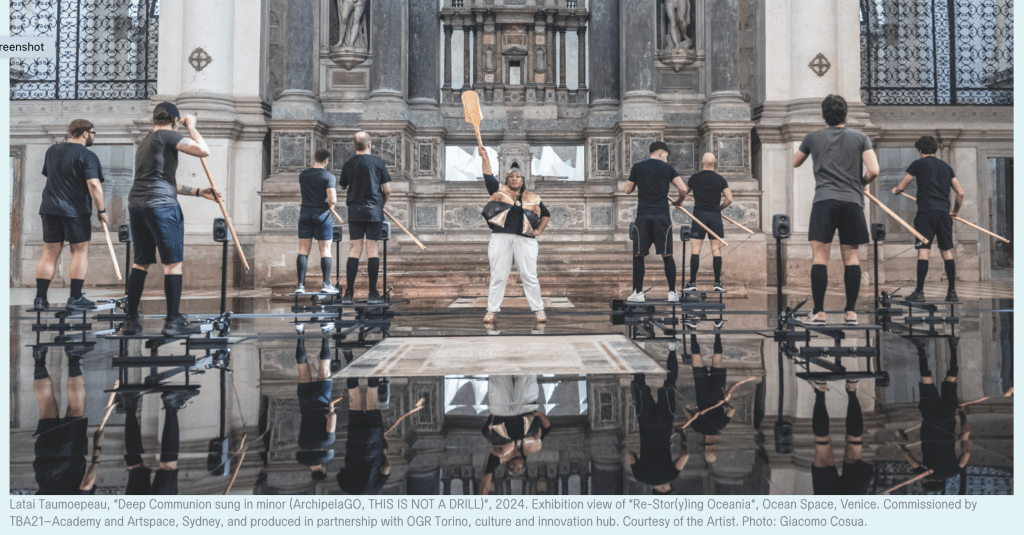
Latai Taumoepeau’s “Deep Communion sung in minor (ArchipelaGO, THIS IS NOT A DRILL)”
Latai Taumoepeau’s participative installation, “Deep Communion sung in minor (ArchipelaGO, THIS IS NOT A DRILL),” addresses the issue of deep-sea mining in the Pacific Ocean. Taumoepeau recreates the ancient Tongan choral ritual Me’etu’upaki—a ceremonial dance involving standing paddles with a 16 channel sound installation. The installation invites visitors to be active participants by rowing paddle machines amplifying the ceremonial song, symbolising collective resistance against DSM. This work honours the ancient practices of Taumoepeau’s ancestors with the goal of encouraging the audience to consider their role in ecological responsibility and the protection of the ocean.
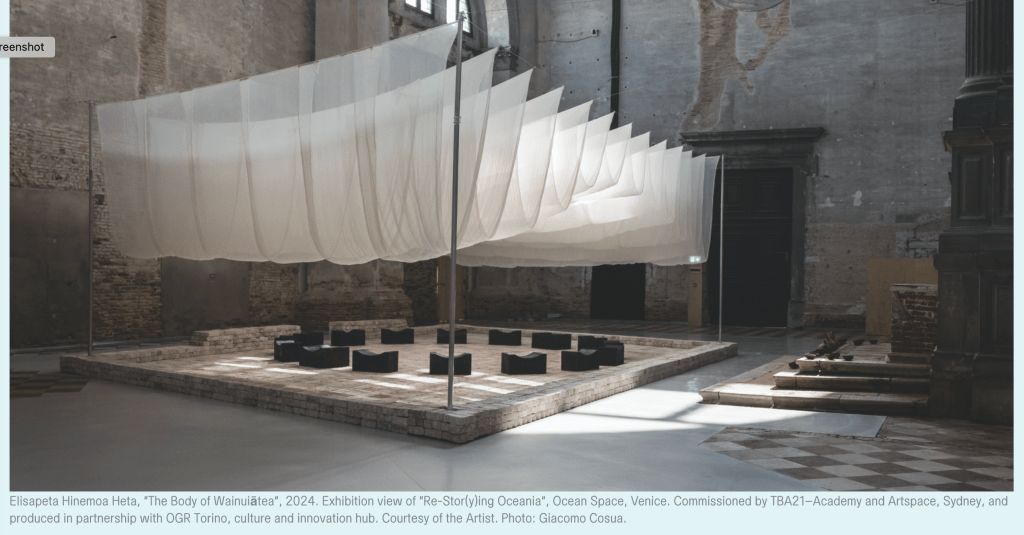
Elisapeta Hinemoa Heta’s “The Body of Wainuiātea”
Elisapeta Hinemoa Heta’s installation, “The Body of Wainuiātea,” creates a space of ritual and ceremony grounded in Māori concepts of kawa and tikanga (the correct way to maintain balance in relationships with the environment). Heta, who is of Māori, Samoan, and Tokelauan descent, used earthen bricks, timber, and textiles to design a space seeking to connect visitors with ancient stories and the sacredness of the ocean. The installation features a series of sixteen seats arranged according to cardinal directions, and above, twelve fabric folds symbolising the heavens. Through karanga (Māori ceremonial calls) and other ceremonial elements, this work encourages visitors to honour Moana (Oceania) as tapu (sacred) to bridge the gap between individual and collective environmental responsibility.
Water always writes in plural…
When I visited this exhibition, I could not help myself and challenged some of the motherhood statements claimed in this exhibition. My main concern was it only represented two artists from Oceania and did not attempt to engage with ideas related to connectivity of the Waters and the impacts of saltwater and freshwater. Although the engagement with climate change, ocean mining and colonisation are very real, live issues for the entire Oceania region, it would have been good to amplify the relational nature of water and the ocean for First Nations people.
To reflect on an early hypertext collaborative writing project by Linda Carroli and Josephine Wilson, Water always writes in plural, Linda states that “collaboration doesn’t necessarily have to result in homogenisation, but rather that there is space for different voices, for partiality.” It is this diversity and plurality which seemed to be absent from this exhibition. Also missing is something I have been increasingly referring to as the OneWater – which is the concept of relatedness, connection and community which gives space for the different voices while bringing them together as part of our experience of this planet – human and more-than-human.
The works themselves were beautifully produced and a thoughtful engagement with the space and the issues. What would have been great is a nod to the decades of interdisciplinary work that have been happening through Intercreate, Treecreate, MEASO Living Data, Ocean Listening and the many more projects from the Oceania region. These examples have raised First Nations voices and cultures as well as demonstrated strong collaboration with scientists and knowledge keepers.
 WEAVING WATER
Leave a comment