
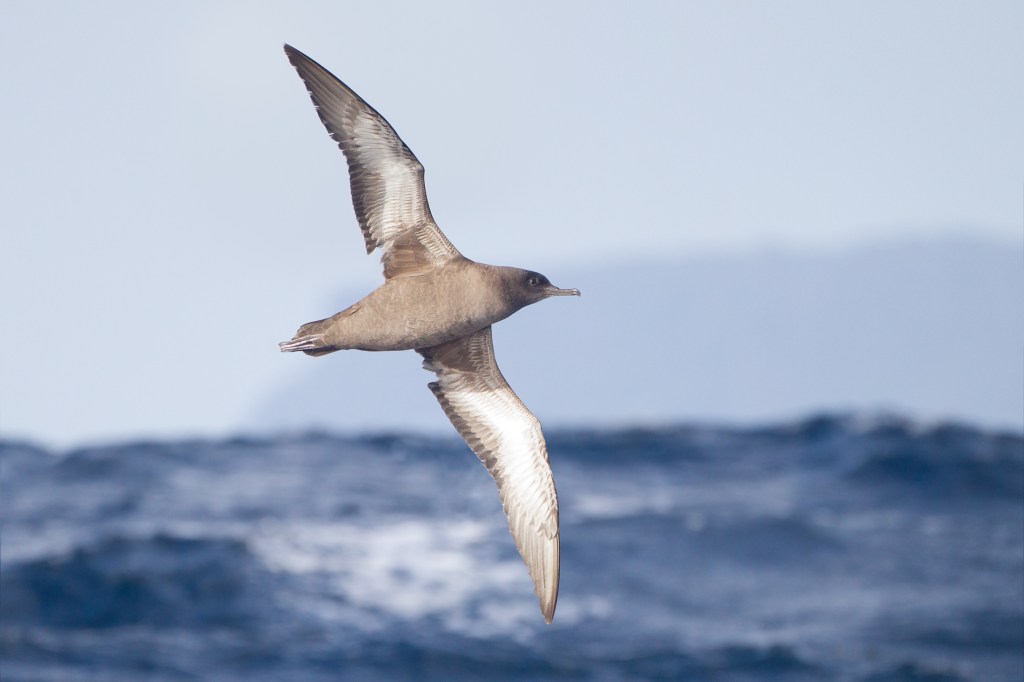
Source: https://upload.wikimedia.org/wikipedia/commons/4/49/Puffinus_griseus_in_flight_-_SE_Tasmania.jpg JJ Harison CC BY SA
[PART 2]
From the facts given in Part 1, we can now build a better picture of Polynesian voyaging and exploration. First of all the Pacific Ocean became known to Polynesians by exploration. They were not forced to travel due to competition for resources, and didn’t just island hop. There is a sequence that occurs long before settlement, which includes finding an island, sharing knowledge of its location, intergenerational knowledge transfer, subsequent visits by other navigators and then settlement on known islands. This could take between three hundred and a thousand years given the expanse of the South Pacific Ocean, Te Moana Nui a Kiwa.
The most telltale sign of an island in the distance is migratory birds on their annual journey. According to Andrew Crowe in Pathway of the Birds: the Voyaging achievements of Māori and their Polynesian ancestors, the sooty shearwater or tītī annually ranges from the Kermadecs to Pitcairn Island (the closest habited island to Easter Island) and South America, and nests in Aotearoa New Zealand. Six million converge on Aotearoa. Some nesting birds fly to the Chatham Islands on a daily basis foraging. Others fly to the sub-Antarctic Auckland Islands, again on a daily basis foraging for food. Between April and November, tītī forage in the northern Pacific with foraging zones including Japan, Siberia, Alaska and the west coast of Turtle Island (the United States).
Some navigators clearly decided to see where the birds went: they were motivated by curiosity. Birds are a navigators friend – some kept birds on board as pets, and they were referred to as ‘the eyes of the navigator.’ At the end of the day, the bird would be released to fly high and look for islands. Also, navigators don’t always require an island to be seen to know it is there. Some would lie on the hull of the waka (canoe) and bodily feel the currents downstream from an island, which lets them know there’s an island ahead. Feeling and/or seeing the texture of the ocean enables navigating to an island from a distance of 34 miles or 55 kilometres according to Crowe.
Once an island is found, its location is recorded in poetic song and transmitted down the generations. The location of the island would then be shared at navigator meetings. It is known in oral traditions that on Ra’iatea, annual meetings of navigators occurred between ca1000 and the 1400’s (according to Denis Kawaharada writing in the Hokulea archive2). It is hard to say for certain whether navigator meetings were held earlier, however the sharing of island knowledge almost certainly would have happened. The transmission of knowledge of islands inter-generationally was really important as many voyages happened beyond the lifetime of the navigator – there was a 200 year gap between the voyages of Kupe and Toi, to Aotearoa New Zealand, according to Te Ara The Encyclopaedia of New Zealand.
So there we have it. From the hard data of the sciences, Polynesian oral traditions about voyaging are confirmed, and new insights into the magnitude and majesty of Polynesian voyaging can now be better understood. The first way we can decolonise knowledge is to acknowledge precedence in Polynesian and Indigenous practices where there is a sound reason for doing so. A second way is to recognise that adventure, exploration, innovation and experienced based reasoning are not confined to the West, but rather a feature of all peoples, including Indigenous.
About the author
Pasha Clothier lives in Aotearoa New Zealand is an eighth generation descendant of Pitcairn Island, known traditionally on Tahiti as Hitiaurevareva. An artist writer, Pasha has exhibited one hundred and eighteen times in seventeen countries, and has twenty five publication credits. Pasha is a nickname given as a child, and is short for ‘Passionate.’
Footnotes
2. Kawaharada, D. (1992). The Voyage to Tahiti. KCCN Hawaiian Radio https://archive.hokulea.com/1992/1992kccnvignettes.html
 WEAVING WATER

Leave a comment