
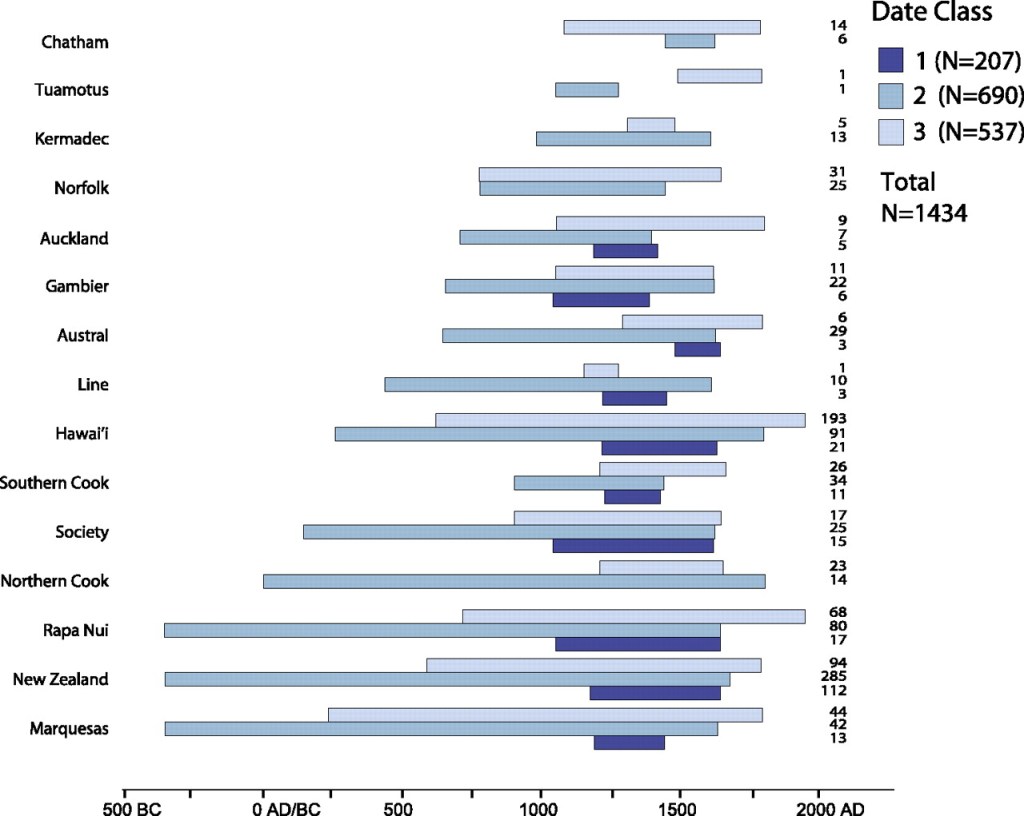
Source: Wilmshurst et al (2011)1. https://www.pnas.org/doi/10.1073/pnas.1015876108 CC BY NC ND
Part 1
Everybody likes a picture but they probably didn’t have in mind a kind of bar graph in monotone blues. They also say every picture tells a story, and this one certainly does. This is the second in a series of blog posts about decolonising. If we ask ourselves, how do we decolonise, a good place to start is to decolonise knowledge. Essentially, over the last five hundred years, it has been Western academics that constructed the history of ideas. Consequently, only Western ideas were taken into consideration. There was a prejudice that the West was innovative, and Indigenous were not – it was prejudiced because instead of looking in a scientific way for signs of innovation in Indigenous groups, assumptions were just made. We live in different times today, and Indigenous practices are now being endorsed by science.
What we are looking at in the image above is data from radiocarbon dating. The chart has a list of Polynesian islands on the left-hand side and a timeline along the bottom. Look for a moment, at the dark blue bars. They are important. If you run your eyes vertically from the bottom, taking in those dark blue bars, you can see there is a sort of overlapping going on, for most of the islands that are listed on the left of the chart. That overlap corresponds roughly to the time period 1190CE to 1290. Some start before that time and some end after. But it is the overlap that is the key thing.
In simple terms, what the dark blue bits are saying is that the permanent settlement of Eastern Polynesia happened in a fairly rapid period, a sudden expansion more or less between 1190 and 1290. This is Hawai’i to the north, Aotearoa New Zealand to the south, and Rapa Nui Easter Island to the east. In oral traditions, the sacred navigator island of Ra’iatea near Tahiti was where this expansion occurred from. The distance from Tahiti to Hawai’i is 3,845 kilometres or 2,390 miles. From Tahiti to Aotearoa New Zealand it is 2,135 kilometres (1,327 miles). And from Tahiti to Rapa Nui is 2791 miles or 4,491 kilometres.
These are huge distances, and this voyaging occurred three hundred and two years before Columbus sailed to America. So the first way to decolonise knowledge is by acknowledging Polynesian precedence, and dropping the idea Columbus was the first person to make trans-oceanic voyages. It doesn’t take anything away from Columbus and his crew’s effort, it is simply acknowledging historical sequence.
If you want to know how they came up with this time period 1190 to 1290, basically the scientists went to known cultural sites, and looked for associated short lived plants and shells. These can be radiocarbon dated with accuracy. The dark blue bars are Class 1 samples, which are the most reliable. Non-cultural sites can also be used, for example, seeds gnawed by the Polynesian rat can be radiocarbon dated.
Check out now, the mid blue bars. They have a really long tail back, but also a degree of imprecision. Those long tail backs extend to around 300BCE. What these are saying is that around this time, with perhaps a range of 100-200 years, someone rocked up to a beach on Aotearoa New Zealand, the Marquesas and Rapa Nui, lit a fire and most likely had a feed. Now this is far out in several senses of that phrase, because it puts someone in a waka (canoe) in Aotearoa New Zealand 1327 miles (2,135 kilometres) from Ra’iatea somewhere between 300BCE and 100BCE. That is an extraordinary accomplishment and indicates that both the technology to build ocean going craft, and the scientific knowledge to sail them, were in place in Polynesia before Christ was on Earth.
About the author
Pasha Clothier lives in Aotearoa New Zealand is an eighth generation descendant of Pitcairn Island, known traditionally on Tahiti as Hitiaurevareva. An artist writer, Pasha has exhibited one hundred and eighteen times in seventeen countries, and has twenty five publication credits. Pasha is a nickname given as a child, and is short for ‘Passionate.’
Footnotes
1. Wilmshurst, J. Hunt, B. Lipo C. and Anderson, A. (2011). High-precision radiocarbon dating shows recent and rapid initial human colonization of East Polynesia. In Proceedings of the National Academy of Sciences February 1, 2011 vol. 108, no. 5, p 1815–1820.
 WEAVING WATER
Leave a comment